
The timing of aids: the invisible factor that changes everything
In riding, many equestrians focus on what they are doing: the intensity of their aids, their position, or their precision. However, a far more decisive factor is often overlooked: when those aids are applied.
This is what we call the timing of aids.
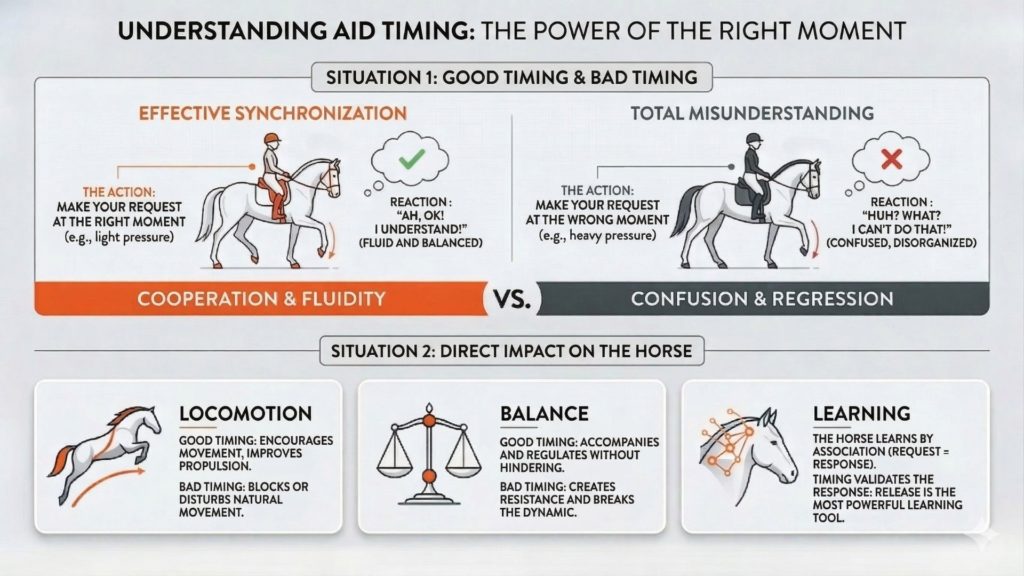
The exact same cue, performed at the right or wrong moment, can produce two completely opposite results:
- Immediate understanding
- Total confusion
Timing is what transforms a “correct” aid into an effective one.
Table des matières
- 1. What exactly is the timing of aids?
- 2. Why timing matters more than intensity
- 3. The direct link to locomotion
- 4. Common timing errors
- 5. How to improve your timing
- 6. Practical exercises to refine your timing
- 7. Timing and release: an inseparable duo
- 8. Impact on performance and well-being
- 9. Toward a more just way of riding
1. What exactly is the timing of aids?
Timing is the rider’s ability to intervene in perfect synchronization with the horse’s movement. Each gait consists of specific phases:
- Footfall (impact)
- Propulsion (push-off)
- Suspension
An effective aid is given at the precise moment the horse is physically capable of responding to it.
Simple Example: Asking for a canter transition.
- Poor timing: Disorganized horse, rushed or “scrambled” departure.
- Good timing: Fluid, balanced transition with no apparent effort.
2. Why timing matters more than intensity
A horse learns through association:
- An action (aid)
- A response
- A consequence (release of pressure)
If the timing is off, the horse may associate the request with the wrong action or fail to understand what is expected. Consequently, even with “correct” aids, learning becomes inefficient. Conversely, a light aid, perfectly timed, is often far more effective than a strong, poorly synchronized one.
3. The direct link to locomotion
Timing directly influences how the horse moves:
- On engagement: A leg aid applied at the right moment encourages hind-limb activity and improves propulsion. Applied at the wrong moment, it blocks or disrupts the movement.
- On balance: A hand used at the right moment regulates the horse without blocking. At the wrong moment, it creates resistance and breaks the forward dynamic.
Timing is a major lever for improving fluidity, regularity, and gait quality.
4. Common timing errors
- Continuous action: Permanent aids cause the horse to “tune out” the requests.
- Acting too late: The horse has already shifted to a different phase of the stride; the aid becomes incoherent.
- Excessive anticipation: The rider acts before the horse is physically ready, causing confusion.
- Lack of coordination: Legs, hands, and seat/weight are not synchronized.
5. How to improve your timing
Timing is a skill that can be developed. Here are the most effective ways to refine it:
- Observe and feel the movement: Learn to feel the rhythm, the stride phases, and the moments of propulsion.
- Simplify your actions: One aid at a time. Short, clear requests. Less information leads to better precision.
- Work slower gaits: At the walk and trot, the movement is easier to read, and the reaction time is longer.
- Video analysis: Allows you to see the lag between what you feel and what is actually happening.
- Use objective data: Tools like Equisense help analyze regularity, tempo, and symmetry to understand if your aids are enhancing or hindering movement.
6. Practical exercises to refine your timing
Exercise 1: Precise transitions. Aim to ask for a transition at the exact moment of a specific stride phase. Observe the quality of the response.
Exercise 2: Apply and release. Give a very brief aid and release immediately. Check if the horse responds without needing repetition.
Exercise 3: Isolation work. Work without hands or without legs to improve global coordination and isolate the effect of each aid.
400+ exercises and programs available on the Equisense app.
7. Timing and release: an inseparable duo
Timing isn’t just about the start of the action; it’s also about the end. Good timing involves:
- Acting at the right moment.
- Stopping at the right moment.
If the aid continues after the response, it becomes interference. The release is what validates the correct answer and allows the horse to learn.
8. Impact on performance and well-being
Proper timing leads to:
- Performance: Faster responses, better precision, and optimized locomotion.
- Well-being: Less tension, clearer understanding, and better mental availability. The horse becomes lighter, more reactive, and more serene.
9. Toward a more just way of riding
Improving your timing means intervening less, but intervening better. It is a shift from “quantitative” to qualitative riding.
Before trying to use more legs, adjust your hands, or “fix” your horse, ask yourself one simple question: “Am I acting at the right moment?”
In riding, correctness doesn’t just depend on what you do… but above all, when you do it.