
Rider Symmetry: the invisible impact on horse locomotion
In riding, we often talk about the horse’s symmetry, but an equally decisive factor is frequently overlooked: the symmetry of the rider.
No rider is perfectly symmetrical. Yet, these often unconscious imbalances have a direct impact on:
- The horse’s locomotion.
- Their posture.
- Their ability to straighten and balance themselves.
Understanding and correcting these imbalances is an essential step toward true progression.
Table des matières
- 1. Why riders are naturally asymmetrical
- 2. How rider asymmetry impacts the horse
- 3. Signs of an asymmetrical rider
- 4. Why this asymmetry hinders progress
- 5. How to identify your imbalances
- 6. Exercises to improve your symmetry
- 7. The importance of consistency
- 8. Impact on performance and the porse
- 9. Toward balanced riding
1. Why riders are naturally asymmetrical
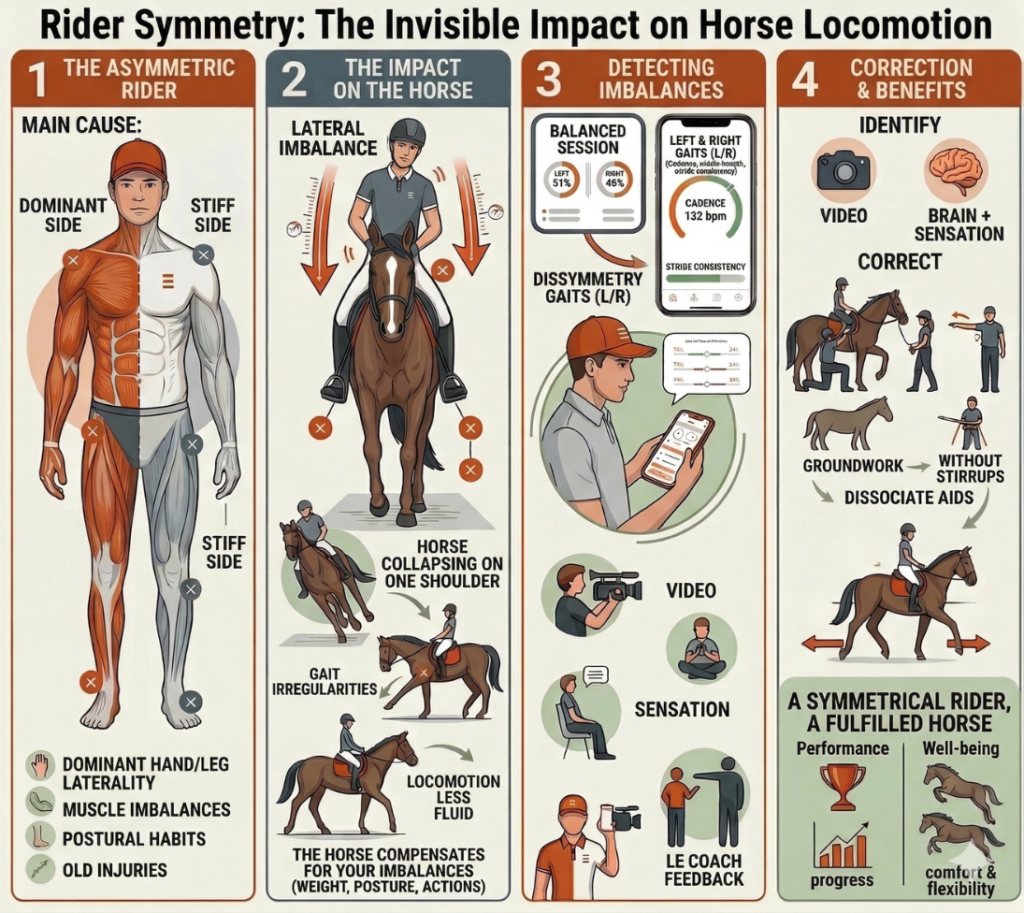
The human body is, by nature, asymmetrical. The main causes include:
- Laterality: Being right-handed or left-handed.
- Muscle Tone Differences: One side often being stronger or tighter than the other.
- Postural Habits: How we sit or stand in daily life.
- Past Injuries: Old traumas that create compensatory patterns.
These asymmetries exist on the ground and are inevitably amplified once in the saddle.
2. How rider asymmetry impacts the horse
The horse is extremely sensitive to weight shifts, even minimal ones.
- Lateral Imbalance: A rider who puts more weight on one side shifts the combined center of gravity. This forces the horse to compensate, often resulting in the horse “falling on the shoulder.”
- Uneven Aids: A more active leg or a dominant hand makes the horse more reactive on one side and stiffer on the other.
- Disruption of Straightness: Even when a rider thinks they are straight, the horse may be curved or “canted.” This complicates all work, including transitions, bend, and overall balance.
Of interest : What can degrade the symmetry of your horse’s gait?
3. Signs of an asymmetrical rider
In the Rider:
- A feeling that one rein or one direction is “easier.”
- Difficulty keeping shoulders aligned.
- Uneven pressure in the stirrups.
In the Horse:
- Bending more easily in one direction.
- Difficulties in specific transitions.
- Irregularity in the contact (taking more bit on one side).
- Difficulty maintaining a straight line.
These signs are often blamed on the horse, when they actually originate from the rider.
4. Why this asymmetry hinders progress
Uncorrected asymmetry leads to:
- Permanent compensations by the horse.
- Asymmetrical physical wear and tear (potential soundness issues).
- Limitations in the quality of work.
The horse cannot develop an evenly balanced physique if the rider is crooked.
5. How to identify your imbalances
- Video Analysis: To visualize shoulder/pelvis alignment and leg position.
- Comparative Feel: Analyze the differences when working on the right rein versus the left rein.
- External Feedback: A coach can detect “invisible” habits and micro-shifts.
- Objective Data: Tools like Equisense help identify asymmetries in locomotion and rhythm variations, linking these effects back to the rider’s posture.
6. Exercises to improve your symmetry
Exercise 1: Weight awareness. Focus on feeling the weight in each stirrup and consciously seeking a 50/50 balance.
Exercise 2: No-stirrup work. This improves pelvic stability and quickly reveals hidden imbalances.
Exercise 3: Dissociation of aids. Practice using each limb independently to avoid “parasitic” movements.
Exercise 4: Off-the-horse training. Core strengthening and mobility work to reinforce weak areas and improve overall posture.
7. The importance of consistency
Correcting your symmetry takes time, repetition, and heightened body awareness. It is not a one-time adjustment but a continuous process of refinement.
8. Impact on performance and the porse
- On Performance: More precise aids, better coordination, and faster progression.
- On the Horse: Smoother locomotion, better straightness (rectitude), and reduced tension.
A more symmetrical rider allows the horse to express its full potential.
9. Toward balanced riding
Working on your symmetry means accepting your imbalances, seeking to understand them, and progressing methodically. It is a decisive but often invisible factor in the quality of your work.
Before seeking to correct your horse, ask yourself: “Am I perfectly balanced myself?”
In riding, the horse’s balance always begins with the rider’s.