
Building an Effective Riding Session : Stop Riding by Chance
Many riders head to the arena with good intentions… but without a real plan. The result? A session that unfolds “by feel,” with exercises chosen on a whim. While this approach can occasionally work, it often plateaus progress.
Building an effective session isn’t about overcomplicating the work; on the contrary, it’s about making it clearer, more consistent, and more productive.
Table des matières
- 1. Why structuring your session is essential
- 2. Define a specific goal
- 3. The 3 phases of an effective session
- 4. The importance of progression
- 5. Most Frequent Errors
- 6. Knowing how to adapt
- 7. Measuring your session’s effectiveness
- 8. Example of a structured session
- 9. Impact on progression
- 10. Toward more intentional riding
1. Why structuring your session is essential
A structured session allows you to:
- Have a clear objective.
- Progress in a logical manner.
- Avoid scattered focus.
- Better understand what is actually working. Without structure, you are working… but without a precise direction.
2. Define a specific goal
Before even mounting your horse, ask yourself one simple question: What is the goal of today’s session? Examples:
- Improving transitions.
- Working on straightness.
- Developing responsiveness.
- Suppling the horse.
Common Mistake: Trying to work on everything in a single session. This leads to a lack of clarity, mental fatigue for the horse, and limited progress.
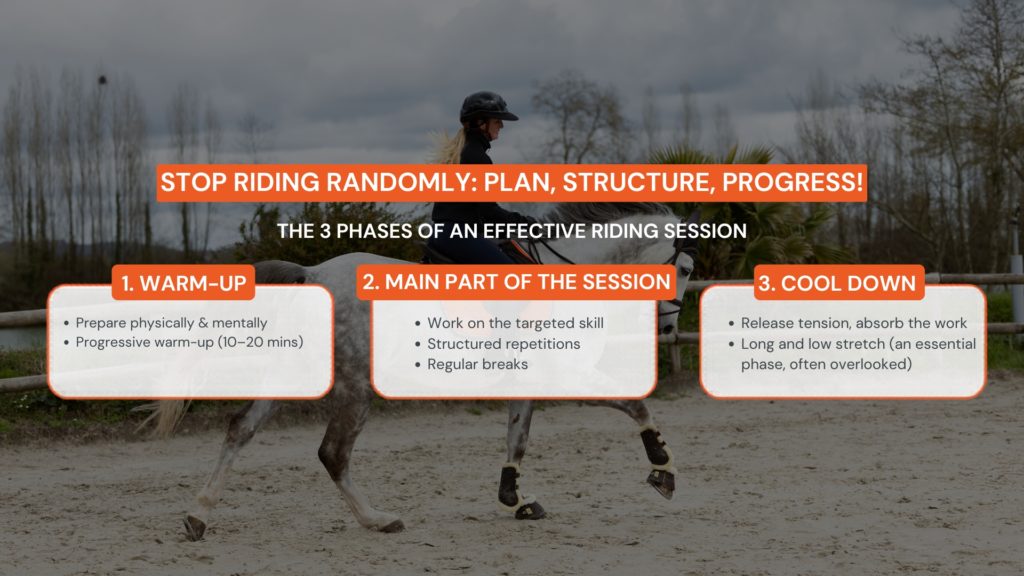
3. The 3 phases of an effective session
- The warm-up (10–20 minutes):
- Objective: Prepare the horse physically and mentally.
- Content: Calm gaits, progressive mobilization, simple exercises.
- The main work (Core of the Session):
- Objective: Work on the targeted goal.
- Content: Progressive exercises, structured repetitions, regular breaks. This is the most strategic part.
- The cool-down:
- Objective: Release tension and allow for mental assimilation.
- Content: Light work, stretching the neck (long and low), recovery. This phase is often neglected but is essential.
4. The importance of progression
A good session follows a logical flow:
Simple → Complex
Known → New
Easy → Demanding
This allows the horse to understand the questions being asked and prevents frustration.
5. Most Frequent Errors
- Constant improvisation: Leads to a lack of consistency.
- Changing goals mid-session: Creates confusion for the horse.
- Drilling for too long: Leads to fatigue and a drop in quality.
- Skipping breaks: Results in mental saturation.
6. Knowing how to adapt
Even with a plan, you must remain flexible. If the horse is tense, tired, or conversely, exceptionally “with you,” you must adjust the session accordingly. The plan serves the horse, not the other way around.
7. Measuring your session’s effectiveness
A successful session doesn’t have to be “perfect.” It should yield a slight improvement, better understanding, or a positive evolution.
- Useful tools: Video, personal feel, and objective data.
- Solutions like Equisense help you track regularity, analyze progress, and objectify the work done.
8. Example of a structured session
- Goal: Improve transitions.
- Warm-up: Basic mobilization + simple transitions.
- Core work: Precise transitions, variations in stride.
- Cool-down: Relaxed work on a long rein.
- Simple, but effective.
9. Impact on progression
- For the rider: Better organization, more clarity, and measurable progress.
- For the horse: Improved understanding, less stress, and more consistency.
10. Toward more intentional riding
Structuring your session means riding with a goal, acting with intention, and progressing with method. Riding “by chance” might feel like work, but it is rarely the most efficient way to improve.
A well-constructed session saves time, improves the quality of work, and helps you understand your horse better. Before you get in the saddle, take a few minutes to think: What do you really want to improve today?In riding, progress doesn’t come from luck… it comes from consistency.