
Feeling vs. Reality: Why Your Perception Might Be Wrong (And How to Truly Progress)
In riding, “feel” is often presented as the ultimate skill. “Feeling your horse,” “listening,” having “good hands”, these are terms celebrated across all disciplines.
However, a disturbing reality remains: a rider’s feel is frequently… wrong. This isn’t due to a lack of talent, but because human perception is naturally limited, biased, and influenced by numerous factors. Understanding the gap between feel and reality is a key step toward objective, effective, and sustainable progress.
Table des matières
- 1. Why “feeling” is naturally biased
- 2. Common perceptual errors
- 3. Why relying solely on feel limits progress
- 4. The Importance of objective data
- 5. Finding the balance between sensation and objectivity
- 6. Exercises to recalibrate your feeling
- 7. The vital role of external feedback
- 8. Impact on performance and well-being
- 9. Toward a more reliable “feeling”
1. Why “feeling” is naturally biased
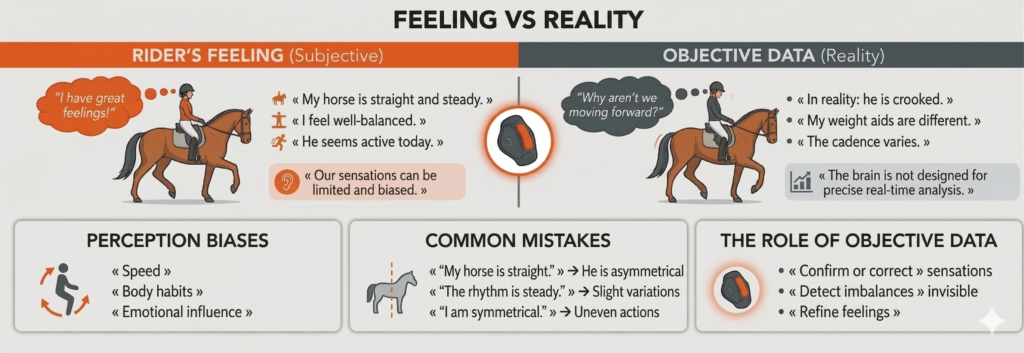
The human brain isn’t designed to precisely analyze complex movements in real-time. Several elements distort our perception in the saddle:
- The speed of movement: Strides happen quickly, making it difficult to accurately analyze rhythm or regularity.
- Unconscious compensation: Riders constantly adapt—balancing, correcting, and compensating. As a result, they may “feel” stability where there is actually underlying instability.
- Body habits: Every rider has asymmetries (pelvis, shoulders, weight distribution). Over time, these imbalances become the “new normal” in their feel.
- Emotional influence: Stress, confidence, and fatigue significantly alter how we perceive movement.
2. Common perceptual errors
- “My horse is straight”: In reality, they might be canted or compensating for the rider’s own asymmetry.
- “The rhythm is regular”: Often, there are slight but constant variations or irregularities invisible without tools.
- “I am symmetrical”: In fact, weight distribution and the intensity of aids are often uneven.
- “He is more active today”: Sometimes, this is just an impression based on perceived energy, without any measurable change in propulsion.
These gaps between feel and reality are normal, but they can plateau your progress.
3. Why relying solely on feel limits progress
The problem isn’t the feeling itself, but using it exclusively.
- Consequences: Difficulty identifying the root cause of problems, repeating mistakes unknowingly, and a sense of stagnation despite hard work.
- Result: You are working hard, but not always in the right direction.
4. The Importance of objective data
To progress, it is essential to compare your feeling against measurable data.
Key Indicators:
- Gait regularity (tempo/rhythm)
- Symmetry
- Cadence
- Engagement
The role of analysis tools: Solutions like Equisense allow you to objectify your work, analyze locomotion, and track evolution over time. This creates a vital bridge between what you feel and what is actually happening.
5. Finding the balance between sensation and objectivity
The goal isn’t to replace feel, but to make it reliable.
The effective approach:
- Feel (Internal perception)
- Verify (Video, data, coach)
- Adjust (Correction based on facts)
This cycle progressively recalibrates your internal sensors.
6. Exercises to recalibrate your feeling
Exercise 1: Guess then check. Estimate your rhythm or speed, then verify with video or a sensor to identify the gap.
Exercise 2: Eyes closed (supervised). Focus entirely on the sensations of the horse’s back and legs, then compare that mental image with reality.
Exercise 3: Single-parameter focus. Focus exclusively on one thing (e.g., rhythm) to avoid information overload.
Of interest : How to follow your progress with Equisense
7. The vital role of external feedback
An outside perspective remains indispensable:
- Coaches for real-time correction.
- Video to see the discrepancy between “feel” and “look.”
- Technological tools for unbiased, mathematical truth.
8. Impact on performance and well-being
Aligning feel with reality leads to:
- Performance: Precise adjustments, faster progression, and consistent training.
- Well-being: Clearer communication, fewer unnecessary constraints, and more logical requests for the horse.
9. Toward a more reliable “feeling”
With time and the right tools, your feel becomes more accurate and stable. Feel is a gift, but it is not infallible.
To progress effectively, you must:
- Accept your sensory limits.
- Confront your sensations with reality.
- Use objective tools.
In riding, progress doesn’t just come from what you feel… it comes from what you truly understand. It is in the alignment of the two that just, effective, and sustainable riding is built.